

DNA sequencers
OpenReadout reads what DNA sequencers write, without the vendor’s software:
| what | format id | page |
|---|---|---|
Illumina run folders: RunInfo.xml, RunParameters.xml, InterOp metrics, BCL and CBCL base calls |
illumina-run |
Illumina run folders |
| Oxford Nanopore raw signal | pod5, fast5 |
POD5 and FAST5 |
| Reads as sequencers and basecallers hand them on (Illumina, PacBio HiFi, Oxford Nanopore) | fastq, bam |
FASTQ and BAM |
| Reference-compressed alignments (CRAM 2.0 to 3.1); bases need the reference, embedded or as a FASTA beside the file | cram |
CRAM |
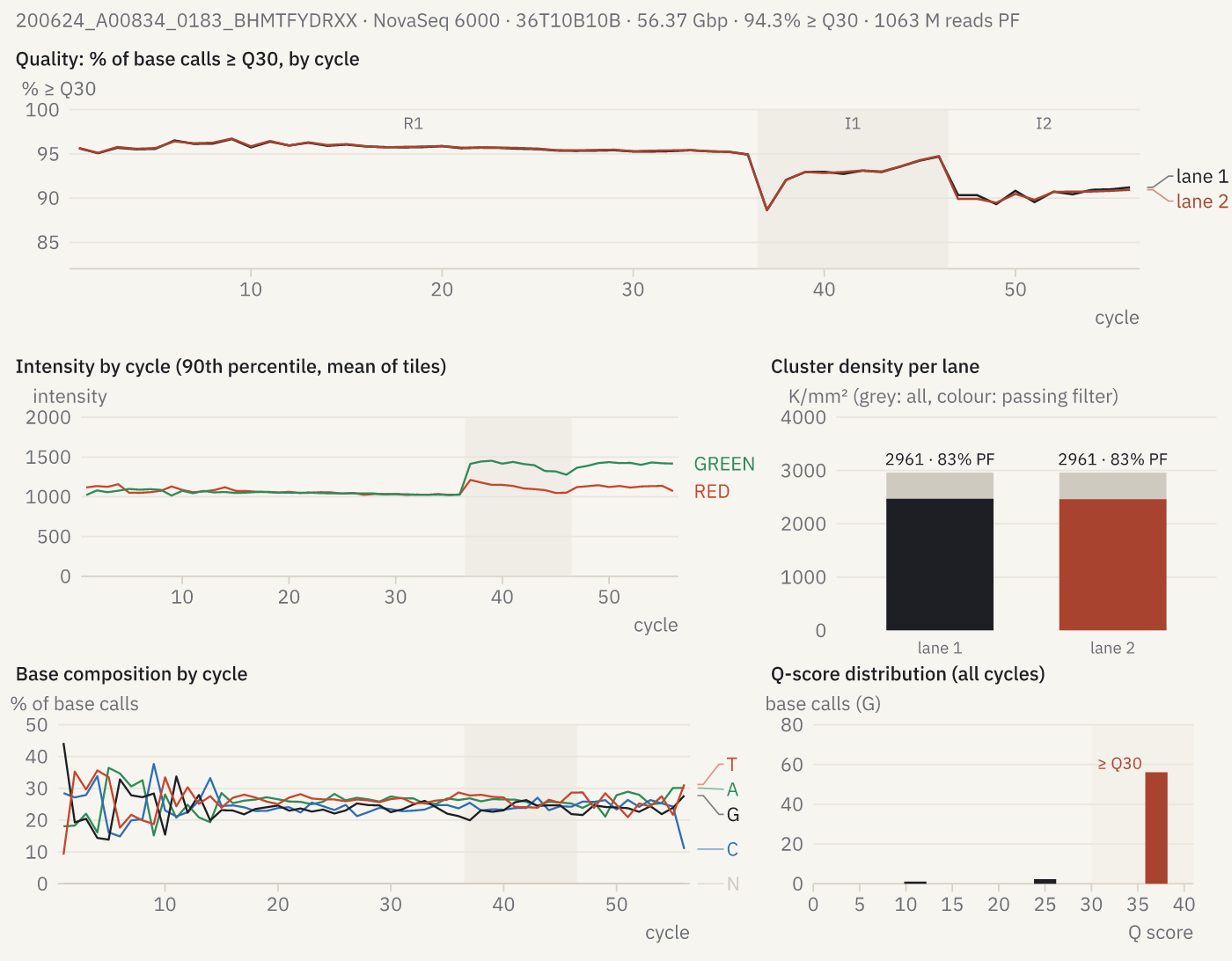
A run folder
info reads the run’s layout and the InterOp metrics, never the base calls, so it answers in
well under a second on a run of terabytes:
$ openreadout info 200624_A00834_0183_BHMTFYDRXX --json | jq '.data.tables[0].extra.totals'{ "yield_gbp": 56.3668, "percent_q30": 94.281, "reads_m": 1276.67, "reads_pf_m": 1063.38, "percent_pf": 83.293, "lanes": 2, "cycles": 56, "read_structure": "36T10B10B"}Table 0 is the run summary per read and lane (density, % passing filter, reads, % ≥ Q30,
yield, error rate, phasing, % occupied), table 1 the metrics per lane and cycle, table 2 per
tile, table 3 the Q-score histogram and table 4 the index counts. Trace 0 holds the quality by
cycle with one sweep per lane, so openreadout trace RUN --sweep 1 is lane 2 and
openreadout plot draws it:
$ openreadout plot '{"data": {"file": "RUN", "y": "percent_q30", "sweep": [0, 1]}}' -o q30.pngopenreadout preview RUN draws the picture above. openreadout export RUN --format fastq
writes gzip FASTQ per lane and read from the base calls (--rows 0-9999 for the first 10,000
clusters of each lane), and openreadout check RUN decodes every base call.
Nanopore reads
Every read is one sweep of trace 0, in picoamperes:
$ openreadout trace HG002.pod5 --sweep 3 --max-samples 5$ openreadout preview HG002.pod5 --sweep 3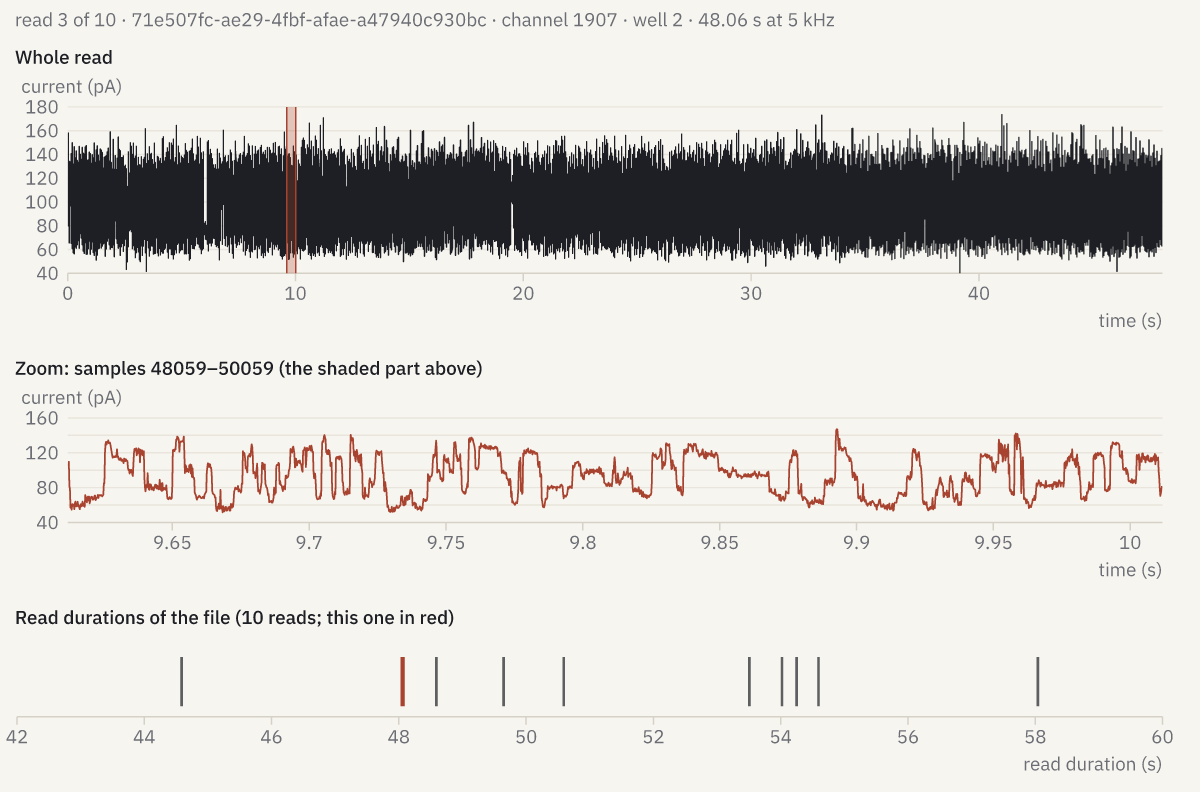
Table 0 lists the reads (channel, well, start, duration, end reason, open-pore level), and
openreadout export HG002.pod5 --format parquet --trace 0 writes every read’s samples to Parquet
(a sweep column numbers the reads; without --trace it writes the reads table).
Read files
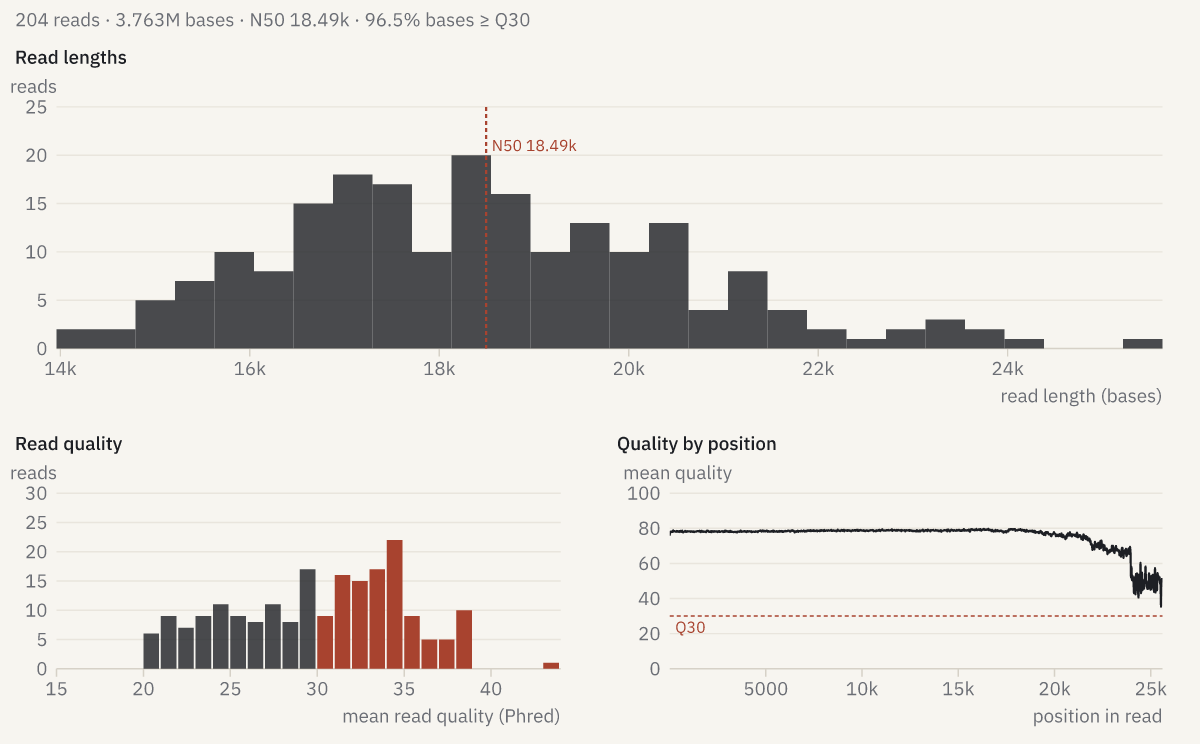
info streams the first 32 MB of a FASTQ or BAM file and reports read counts, the N50, %
bases ≥ Q30 and GC; it says when counts are estimated, and check reads every record.
Across runs
batch compares runs: one row of instrument, run and sample facts per run folder, or the
columns of the run summary per run:
$ openreadout batch info 'runs/*/' -o runs.csv$ openreadout batch table 'runs/*/' --set table=0 --set 'parameters=["percent_q30", "yield"]' -o q30.csvNot read
Ion Torrent (.wells, .dat), MGI and Element Biosciences run folders, PacBio raw movie and
.baz files, Sanger and fragment-analysis traces are not read yet. CRAM is not read; samtools
reads it.