

Thermo Fisher Qubit exports
Qubit fluorometers measure DNA, RNA and protein concentration with dye assays. The Qubit 4 and Qubit Flex export their results as CSV. OpenReadout reads both as a table of samples with units. Derived from public export files with allotropy (MIT) as the reference reader. Provenance: docs/provenance/qubit.md. Crate: openreadout-benchtop.
| format id | files | reads | confidence |
|---|---|---|---|
qubit |
Qubit 4 and Qubit Flex exports (.csv) |
one row per tube: run, assay, sample, time, tube and original sample concentrations with their units, sample volume, dilution, the standards’ and the sample’s fluorescence | see cargo xtask assurance-audit |
Not read: Excel saves of the exports. Concentrations are the Qubit’s own, as stored; the standard curve is not refitted.
Layouts
| layout | header | notes |
|---|---|---|
qubit-4 |
Run ID,Assay Name,Test Name,Test Date,Qubit® tube conc.,Units,Original sample conc.,Units,Sample Volume (µL),Dilution Factor,Std 1 RFU,Std 2 RFU,Std 3 RFU,Excitation,Emission,Green RFU,Far Red RFU |
each Units column holds the unit of the concentration before it. The run id is the run’s date (2023-11-04), which settles the day and month order of Test Date (04/11/2023) |
qubit-flex |
Run ID,Test Date,Assay Name,Sample Name,Original Sample Conc.,Original sample conc. units,Qubit Tube Conc.,Qubit tube conc. units,... |
may start with a sep=, line. Qubit Flex 1.5 writes seven trailing columns without titles; the reader names them as the Flex’s documented columns (Plate Barcode, Well, Sample ID, Tags, Calibrated Tubes, Software Version, Selected Samples) and says so in a note |
A concentration cell may hold text instead of a number (Out of range); it is kept in the <name>_note column next to the concentration.
What the reader returns
-
Table 0
samples(extra.kindsamples), one row per tube read:name meaning unit run_id,assay,samplethe run, the assay ( 1x dsDNA High Sensitivity,RNA BR), the sample (Test Name,Sample Name)measured_atthe test date and time, ISO 8601 tube_concentration,sample_concentrationthe concentration in the assay tube and in the original sample as the units columns state ( ng/mL,ng/µL,µg/mL)tube_concentration_note,sample_concentration_notetext in place of a concentration ( Out of range)sample_volume,dilution_factorsample volume and dilution µLstd1_rfu,std2_rfu,std3_rfu,green_rfu,far_red_rfu,sample_rfufluorescence of the standards and the sample RFUexcitation,emissionthe light used extended_low_range,core_range,extended_high_range,standards_read_at,reagent_lot,plate_barcode,well,sample_id,tags,calibrated_tubes,software_version,selected_samplesQubit Flex columns -
Experiment: instrument Thermo Fisher Scientific Qubit 4 or Qubit Flex, software version (Flex); method name the assay, technique fluorescence detection; acquisition from the earliest to the latest test time; the dilution factor when every tube shares it.
-
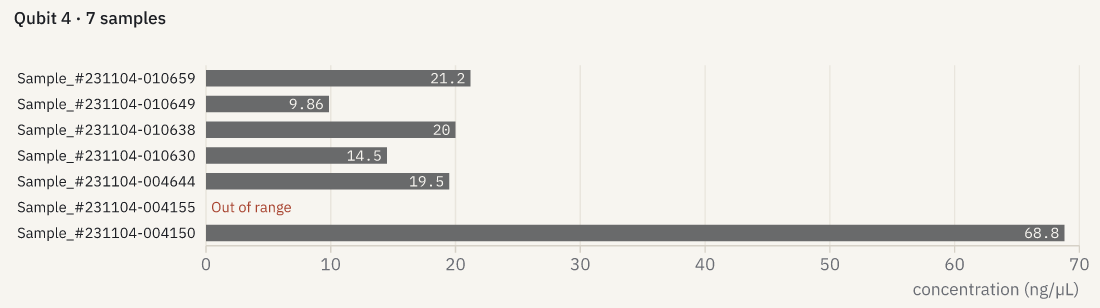
previewdraws each sample’s concentration as a bar, with the instrument’s text where it wrote no number. -
batch tablegives every row of every file.
Validation
cargo test -p openreadout-corpus-tests --features corpus (tests/corpus/benchtop_oracle/mod.rs, oracle/benchtop_oracle.py): allotropy’s ASM, per tube in file order: the sample name, the tube and original sample concentrations (unit-converted) and the fluorescence. allotropy reads Test Date month first, so where the run id says otherwise the two disagree on the date; dates are not compared.
Vocabulary (public API of openreadout-benchtop, Qubit)
| identifier | meaning |
|---|---|
QubitReader |
reader of Qubit exports |
QUBIT_FORMAT_ID |
qubit |
SampleTableDataset |
the dataset the NanoDrop and Qubit readers return |
fuzz_qubit |
parse a Qubit export from bytes (fuzz targets only) |
Pictures
openreadout preview draws each sample’s concentration as a bar, with the instrument’s text where it wrote no number:
Examples
openreadout info run.csv # assay, instrument, tubesopenreadout table run.csv # one row per tube, with unitsopenreadout batch table qubit/ -o all.csv # every export of a folder as one tableHow this reader was derived, file by file: provenance log.